








The Right to Information (RTI) Act, 2005 gives eligible citizens of India a legal way to seek information from public authorities. RTI can be useful when you want to know how a government department made a decision, how public money was used, the status of a government record, or what information is available in an official file.
For many Central Government public authorities, an RTI application can be submitted online through the official RTI portal.
This guide explains the RTI application process, eligibility, fees, documents, online filing, status tracking, appeal process and important rules.
What Is RTI?
RTI stands for Right to Information.
Under the Right to Information Act, 2005, citizens can request information held by or under the control of public authorities, subject to the exemptions and other provisions of the Act.
The purpose of RTI is to promote:
- Transparency
- Accountability
- Access to government information
- Better public participation
- Transparency in public administration
RTI is not normally a mechanism for asking a government officer to create a new explanation or opinion. It is mainly used to obtain information or records that are available with the public authority.
Who Can File an RTI Application?
Under the RTI Act, Indian citizens can seek information under the Act.
An RTI application can generally be filed by an individual citizen without needing to explain why the information is required.
You usually do not need to:
- Hire a lawyer
- Visit a government office personally
- Explain your reason for seeking the information
However, the application should clearly identify the information you want.
What Information Can You Ask for Through RTI?
The RTI Act covers information held by or under the control of a public authority.
Depending on the case, you can seek:
- Government records
- Documents
- Orders
- Circulars
- Reports
- Office notes, where disclosable
- Records of decisions
- File-related information
- Certified copies of documents
- Data available in government records
- Inspection of records
- Information about government expenditure
For example, instead of asking:
“Why has my application been delayed?”
you can frame the request more specifically:
“Please provide the current status of my application and certified copies of the records showing action taken on my application from [date] to [date].”
This makes the request easier for the Public Information Officer to process.
What Cannot Usually Be Asked Through RTI?
RTI does not mean that every question asked to a government department must be answered.
Certain information is exempt under the RTI Act.
Exemptions can cover areas such as:
- National security
- Information that may affect certain investigations
- Certain personal information
- Commercial confidence in specified circumstances
- Information protected by other legal provisions
- Certain confidential relationships
- Other categories covered under the Act
The exact exemption depends on the information requested.
RTI Application Online – Step-by-Step Process
Step 1: Identify the Public Authority
First determine which government department or public authority is likely to hold the information.
For example, your information might relate to:
- Ministry
- Central Government department
- Government office
- Central public authority
- Other organisation covered by the RTI Act
Choosing the correct public authority can make the process faster.
Step 2: Visit the Official RTI Online Portal
For eligible Central Government RTI applications, use the official RTI Online portal.
Avoid websites that charge money simply for submitting an RTI when you can use the official government portal.
Step 3: Register or Use the Portal
Follow the instructions on the official portal to submit an RTI application.
You will need to provide the information requested by the portal.
Step 4: Select the Public Authority
Choose the relevant public authority from the available list.
If you select the wrong authority, the application may need to be transferred or may not produce the information you expected.
Step 5: Write Your RTI Request
Clearly list the information you want.
Keep each question specific.
For example:
- Please provide the current status of my application number ______.
- Please provide the date on which the application was received.
- Please provide copies of records showing action taken on the application.
- Please provide the name and designation of the officer responsible for processing the application, as available in official records.
Avoid asking long questions that require the officer to provide opinions or explanations that are not contained in government records.
Step 6: Upload Documents if Required
The application can generally include supporting documents where relevant.
Do not upload unnecessary personal documents.
If a document is needed to identify your application, attach a clear copy.
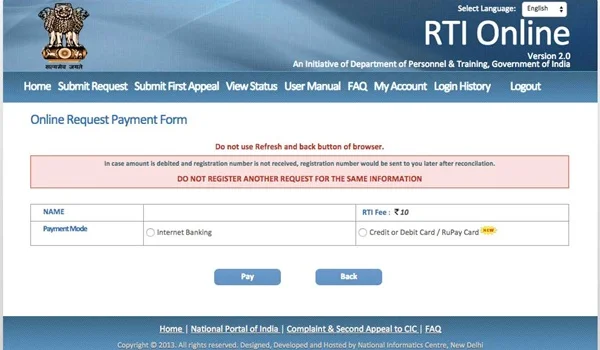
Step 7: Pay the RTI Application Fee
The prescribed RTI application fee is generally ₹10 for applicants who are not exempt.
Applicants belonging to eligible Below Poverty Line (BPL) categories are exempt from payment of the application fee under the applicable rules, subject to the required conditions.
The portal provides online payment options.
Step 8: Submit the Application
Review all details carefully before submitting.
After successful submission, keep the acknowledgement or registration number.
You can use it to track your application.
RTI Application Fee
For Central Government public authorities, the standard RTI application fee is generally:
₹10
The exact fee and payment rules can depend on the applicable RTI rules.
BPL applicants are generally exempt from the application fee, subject to applicable requirements.
Additional fees may sometimes be payable for providing information, such as copies of documents, depending on the quantity and applicable rules.
What Documents Are Required for RTI?
Generally, you do not need a large set of documents to file an RTI application.
Depending on your application, you may need:
- Basic applicant details
- Contact information
- RTI application text
- Supporting document, if relevant
- BPL proof, if claiming the applicable exemption
Do not send unnecessary documents.
RTI Application Format
There is no need to write a complicated legal petition.
A simple structure can be:
To:
The Public Information Officer
[Public Authority]
Subject: Application under the Right to Information Act, 2005
Information requested:
- Please provide ______.
- Please provide a certified copy of ______.
- Please provide the current status of ______.
- Please provide records relating to ______.
Applicant:
Name: ______
Address: ______
Contact details: ______
Keep the questions clear and focused.
How to Write a Good RTI Application
A well-written RTI application should be:
Specific
Ask for clearly identifiable information.
Short
Avoid unnecessary background stories.
Record-Based
Ask for documents, records, data, dates or certified copies where possible.
Numbered
Use numbered questions so each point can be answered separately.
Neutral
Avoid emotional language or accusations.
For example, instead of:
“Why is your department deliberately delaying my file?”
write:
“Please provide the date-wise details of action taken on my application from 1 January 2026 to 31 July 2026.”
Can RTI Be Filed Without Aadhaar?
An Aadhaar card is generally not a mandatory requirement simply for exercising the RTI right.
However, the online portal requires certain applicant details to process the application.
Do not provide unnecessary identity documents unless the applicable process requires them.
Can RTI Be Filed Anonymously?
Generally, RTI applications are not designed as completely anonymous applications.
The applicant provides required details to the public authority.
However, you do not generally have to explain why you want the information.
RTI Response Time
Under the RTI Act, information is generally required to be provided within 30 days from receipt of the request by the public authority.
There are important exceptions.
For example, where the information sought concerns the life or liberty of a person, the applicable response period is generally 48 hours.
If an RTI application is submitted to an incorrect public authority but is transferred under the applicable provisions, the transfer is generally required within the prescribed period.
The actual timeline can depend on the circumstances and statutory provisions.
What If You Do Not Receive an RTI Reply?
If the prescribed period has passed and you have not received a response, you may have the right to file a First Appeal.
A first appeal can also be relevant when:
- Information is incomplete
- Information is incorrect
- Information is denied
- Excessive fees are demanded
- You disagree with the decision of the PIO
RTI First Appeal
The first appeal is generally filed before the First Appellate Authority (FAA) of the concerned public authority.
You can file an appeal when you are dissatisfied with the response or when no response is received within the applicable period.
The appeal should explain:
- RTI application details
- Date of application
- PIO response, if any
- Why you are dissatisfied
- Information or relief sought
For Central Government matters that support online filing, the RTI Online system can provide facilities for filing appeals.
RTI Second Appeal
If you remain dissatisfied after the first appeal, a second appeal may be filed before the appropriate Information Commission, subject to the RTI Act and applicable procedure.
For Central Government matters, the relevant authority is generally the Central Information Commission (CIC).
State Government matters generally fall under the relevant State Information Commission.
RTI Complaint vs First Appeal
These are different remedies.
RTI First Appeal
Used when you are dissatisfied with the PIO’s response or do not receive information within the applicable period.
RTI Complaint
A complaint can be made to the relevant Information Commission in circumstances covered by the RTI Act, such as certain situations involving refusal to accept an application or access-related issues.
The appropriate remedy depends on what happened in your case.
Can You File RTI Against State Government?
Yes, RTI applies to public authorities covered by the Act at both Central and State levels.
However, the RTI Online portal of the Central Government is primarily for Central Government public authorities.
For State Government departments, you should check whether the relevant state has its own RTI online portal or follow the applicable state procedure.
Do not assume that an RTI intended for a State department can always be filed through the Central RTI Online portal.
RTI for Municipal Corporation
You may be able to seek information from a municipal corporation if it is a public authority covered by the RTI Act.
Depending on the state and municipality, you may need to use:
- State RTI portal
- Municipal RTI mechanism
- Offline application
- Other applicable government procedure
Check which authority holds the records before filing.
RTI for Police Department
Police departments are generally subject to RTI, but certain information can be exempt.
For example, information affecting an investigation or other protected interests may be denied under applicable exemptions.
If you want information about a police complaint, FIR or investigation, clearly identify:
- Police station
- Complaint/FIR number
- Date
- Relevant records requested
The exact information that can be disclosed depends on the law and circumstances.
RTI for Passport
If you have a passport-related issue, you can potentially seek information from the relevant public authority if the information falls within the RTI framework.
Instead of asking:
“Why are you delaying my passport?”
you could request:
“Please provide the current status of my passport application and certified copies of records showing action taken on application number ______.”
RTI for Government Job Recruitment
RTI can be used to seek certain information relating to government recruitment, subject to applicable exemptions and privacy rules.
Possible requests may include:
- Recruitment rules
- Number of vacancies
- Official cut-off information where available
- Selection criteria
- Marks or records where disclosure is legally permissible
- Copies of relevant official documents
Personal information relating to other candidates may be protected from disclosure.
RTI for Government Schemes
RTI can help citizens seek information about government schemes.
For example, you may request:
- Number of beneficiaries
- Funds allocated
- Funds spent
- Official guidelines
- Sanction orders
- Implementation records
- Status of an application
The information must be available with or under the control of the relevant public authority.
RTI for Property and Land Records
Land and property records are generally maintained by the relevant state or local authorities.
Depending on the state, you may use RTI to request available government records concerning:
- Land records
- Mutation status
- Official orders
- File movement
- Government action
- Copies of records
However, RTI does not replace the normal process for obtaining certified land records where another prescribed procedure exists.
Can RTI Ask “Why”?
This is one of the most important points.
An RTI application should preferably seek information that already exists in government records.
Instead of:
“Why did the officer reject my application?”
you could ask:
“Please provide a certified copy of the order rejecting my application and the records relied upon for the decision.”
This approach focuses on existing records.
Can RTI Ask for Personal Information?
You may request information concerning yourself in appropriate circumstances.
However, personal information relating to another person can be subject to exemptions under the RTI Act.
Privacy and public-interest considerations may affect whether such information can be disclosed.
Can RTI Ask for Certified Copies?
Yes.
You can request certified copies of records where the applicable law permits disclosure.
For example:
“Please provide a certified copy of the order dated ______.”
If the record is disclosable, the public authority can provide it according to the applicable procedure and fee rules.
Can RTI Ask to Inspect Government Records?
Yes.
The RTI Act includes the right to inspect certain works, documents and records.
Inspection can be useful when a file contains a large number of documents and you first want to examine the records before requesting copies.
What Happens After Filing an RTI?
The Public Information Officer examines your request.
Possible outcomes include:
- Full information provided
- Partial information provided
- Information denied under an exemption
- Application transferred to another public authority
- Additional fee requested
- Clarification or other procedural communication
If you disagree with the response, you can use the applicable appeal mechanism.
Common RTI Mistakes
Asking Too Many Questions
A very long application can make the request difficult to process.
Asking for Opinions
Ask for existing records rather than asking the officer to provide personal explanations.
Selecting the Wrong Department
Identify the authority that actually holds the records.
Using Emotional Language
Keep the application factual.
Not Saving the Registration Number
You need the reference number to track the application.
Missing the Appeal Deadline
If you want to challenge a response, check the applicable limitation period for filing an appeal.
RTI First Appeal Time Limit
The RTI Act generally allows a first appeal to be filed within 30 days from the expiry of the response period or from receipt of the PIO’s decision, subject to the provisions relating to delay.
An appellate authority can admit a delayed appeal where sufficient cause is shown.
Because appeal circumstances can vary, check the applicable statutory requirements before filing.
RTI Second Appeal Time Limit
A second appeal to the appropriate Information Commission generally needs to be filed within 90 days from the date on which the decision should have been made or was actually received, subject to the applicable provisions.
Delay may be condoned where sufficient cause is shown.
Frequently Asked Questions
What is RTI?
RTI is a legal mechanism under the Right to Information Act, 2005 that allows citizens to seek information held by or under the control of public authorities, subject to statutory exemptions.
Can I file RTI online?
Yes, eligible Central Government RTI applications can be submitted online through the official RTI Online portal.
What is the RTI application fee?
The standard application fee for Central Government RTI applications is generally ₹10, subject to applicable rules and exemptions.
How long does an RTI reply take?
The general period is 30 days, although certain situations have different statutory timelines.
Can I file RTI against a private company?
RTI applies to public authorities covered by the Act. A private company is not automatically subject to RTI merely because it is a private company. However, information relating to a private body may sometimes be accessible through a public authority where the public authority is legally entitled to access it.
Can I file RTI without a lawyer?
Yes. You can generally file an RTI application yourself.
Can I file RTI against a police department?
Yes, subject to the RTI Act and applicable exemptions.
What if my RTI application is rejected?
Read the reason for rejection. If you believe the denial is incorrect, you can generally file a first appeal.
Can I appeal an RTI response?
Yes. The RTI Act provides first and second appeal mechanisms, subject to applicable conditions and time limits.
Can I ask for government file copies through RTI?
Yes, disclosable records and certified copies can generally be requested.
Official RTI Portal
For Central Government RTI applications, use the official government portal:
RTI Online – Government of India
For State Government departments, check the relevant state government’s official RTI system.
Final Verdict
RTI is a powerful legal tool for obtaining information from public authorities, but the quality of the application matters.
A good RTI application should follow a simple approach:
Identify the authority → Ask for existing records → Keep questions specific → Pay the applicable fee → Save the registration number → Track the response → File an appeal if necessary
The most effective RTI applications are usually clear, factual and record-based.
Instead of asking an officer to explain or justify a decision, ask for the documents, orders, records, dates and information that show how the decision was made.
This article is for general educational purposes and does not constitute legal advice. RTI procedures, fees, exemptions and government portal facilities can change. Verify the latest requirements through the official RTI portal or the relevant public authority before filing.